
Heloise Roberts and Moira Fearby
- Drawing
- Painting
Roberts & Fearby's artworks offer an alternative mode of engagement with the natural world. This is art as gentle witness. They focus on what is precious, what is worth protecting, what is already being carried forward in memory.


Opening Hours
- Sat 12 Sept10am - 4pm
- Sun 13 Sept10am - 4pm
- Mon 14 Sept10am - 4pm
- Tue 15 SeptClosed
- Wed 16 SeptClosed
- Thu 17 Sept10am - 4pm
- Fri 18 Sept10am - 4pm
- Sat 19 Sept10am - 4pm
- Sun 20 Sept10am - 4pm
- Mon 21 Sept10am - 4pm
- Tue 22 SeptClosed
- Wed 23 SeptClosed
- Thu 24 Sept10am - 4pm
- Fri 25 Sept10am - 4pm
- Sat 26 Sept10am - 4pm
- Sun 27 Sept10am - 4pm
- Parking suitable for cars
- Parking suitable for buses
- Family friendly (suitable for children)
- Refreshments available
Roberts and Fearby met as teenagers at art school and have since developed a collaborative practice interrogating place, identity, and environmental consciousness. Their work has received several awards, including the 2025 Ludlow Landscape Prize, the 2013 Black Swan Heritage Prize for 'Living City', and the Castaways Sculpture Award Sustainability Prize in 2021 and 2023 for 'Pathogen' and 'Insidious' respectively. They have been finalists in the Black Swan Portrait Prize (2014, 2016) and the 2024 Perth Royal Art Prize for Landscape with 'Echoes of Duality—Sugarloaf Rock'. Most recently, they were selected for 'Tracework', a survey of contemporary art in the Southwest at Bunbury Regional Art Gallery.
In 2024, they began a series of large-scale landscapes evoking memory and place. Crafted from drawn and painted plywood tiles.
Their work reimagines landscape as an active collaborator—shaping identity through memory, materiality, and movement. Their work traces these entangled geographies, where place becomes a site of shared belonging that invites viewers to reflect on their own spatial narratives. This body of work extends their fascination with the natural landscape that has shaped them, exploring how familiarity and distance shape memory.
In an era of climate anxiety, the work offers an alternative mode of engagement with the natural world. These works do not shout or accuse; they ask viewers to remember what they love—and to consider, quietly, what it would mean to lose it. This is art as gentle witness. In this body of work the artists have turned toward what is precious, what is worth protecting, what is already being carried forward in memory.
More studios in Margaret River
Nancy Tost
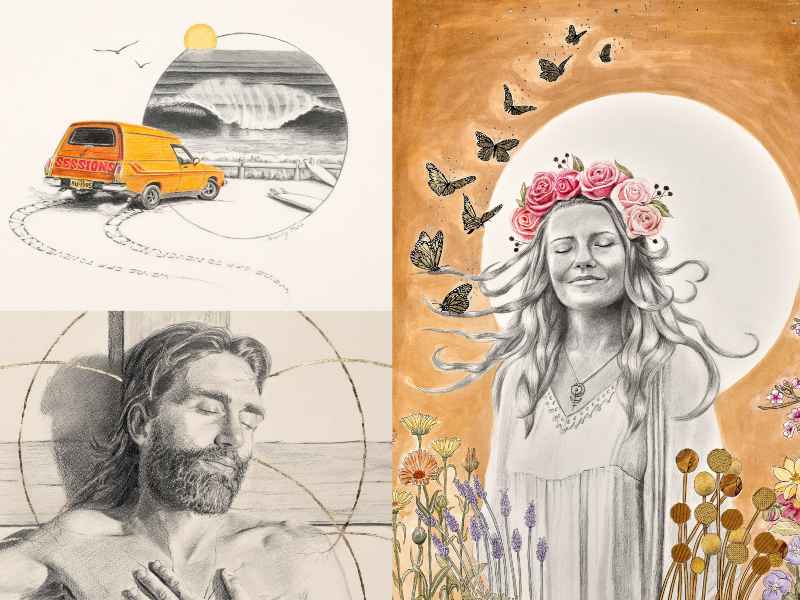
I love to create though drawing, painting, sewing, and printing. This year I have nudes (charcoal), original art, t-shirts, cards, prints, bags, and many other creations!